
On this day in military history…
On 10 August 1961, an aircraft passed low over the countryside of South Vietnam and released a chemical spray across the vegetation below. At the time it was regarded as an experimental military measure designed to strip away the dense tropical foliage that provided Communist guerrillas with concealment. Few could have imagined that this relatively small trial would develop into one of the most controversial military programmes of the Vietnam War and leave consequences that would still be debated more than half a century later.
The first trials took place in the Central Highlands region of South Vietnam. The objective was straightforward from a military point of view. Viet Cong guerrillas relied heavily upon jungle, roadside vegetation and thick undergrowth to conceal their movements, establish ambushes and hide bases and supply routes. Roads passing through heavily vegetated country could be particularly dangerous. A convoy might be travelling through apparently empty terrain when enemy troops hidden only yards away suddenly opened fire. By removing the foliage along roads, around military installations and in other strategically important areas, American and South Vietnamese planners hoped to improve visibility and deny guerrillas one of their greatest advantages.
The spraying that began in August 1961 was initially experimental. United States government documents later recorded that defoliation trials were carried out at thirteen locations beginning that month. Approximately 87 miles of communication routes were cleared, together with areas surrounding military installations. The stated purpose was to provide better fields of fire and reduce the possibility of ambush. Even within the American government, however, there were already questions about how militarily effective the technique really was. Improved visibility was undeniable, but some officials pointed out that bare tree trunks, branches and terrain features could still provide considerable concealment.
The chemicals being tested were herbicides rather than conventional battlefield poison gases. Their purpose was to kill vegetation rather than directly attack enemy soldiers. Among the early chemicals used was a mixture that became known as Agent Purple. It contained herbicidal compounds including 2,4-D and 2,4,5-T. The better-known Agent Orange would later contain equal quantities of those same two principal herbicides. Its name had nothing to do with the colour of the liquid itself; it came from the orange identifying stripe painted around the drums in which it was stored.
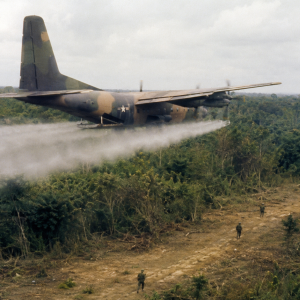
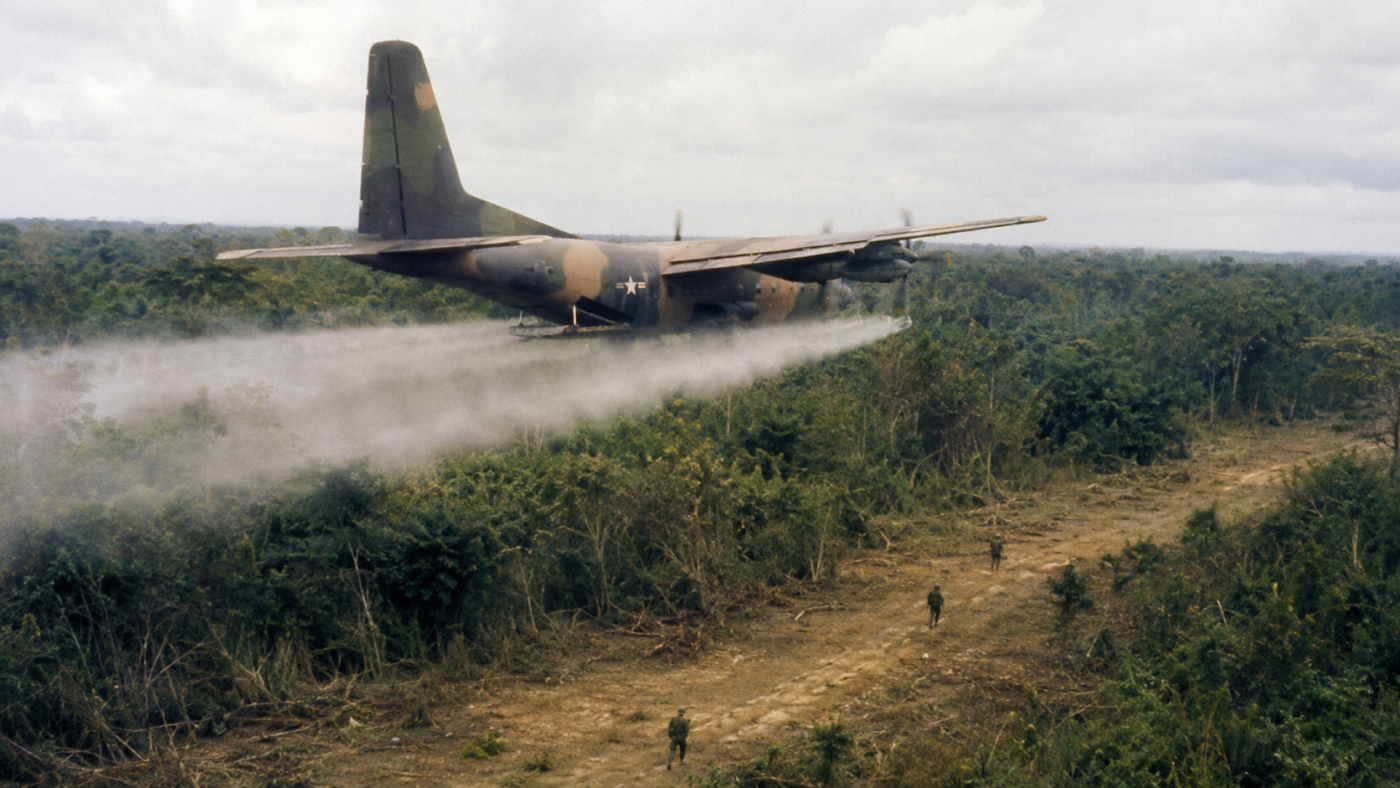
What began as experimental spraying quickly developed into something far larger. By early 1962 the United States Air Force had begun Operation Ranch Hand, the programme that would become synonymous with aerial defoliation in Vietnam. Specially equipped aircraft flew low over forests, mangrove swamps, roads and suspected enemy areas while releasing herbicide from spray equipment installed inside the aircraft. C-123 Provider transport aircraft became particularly associated with the operation, although helicopters, trucks, boats and hand-operated equipment were also used in herbicide operations.
The crews carrying out the missions were known informally as the Ranch Handers. Flying a spraying mission could be extremely hazardous. The aircraft needed to remain low and relatively steady to distribute the chemicals effectively, placing them within range of small-arms and ground fire. They were often flying over precisely the areas believed to contain Viet Cong or North Vietnamese forces. In many cases armed aircraft provided cover while the lumbering C-123s made their runs.
The programme had two principal military objectives. The first was defoliation: removing leaves from forests and vegetation to expose enemy movements, camps, trails and ambush positions. The second, much more controversial objective was crop destruction. Communist forces depended upon food produced or collected in rural areas, and destroying crops believed to be supplying them was seen as another way of reducing their ability to operate.
Crop destruction immediately created difficult questions. Rice fields and other crops did not necessarily belong to Viet Cong fighters. They could belong to ordinary Vietnamese farmers whose families depended upon the harvest. American officials themselves recognised that destroying food could alienate the rural population and potentially drive civilians towards the Communist cause. A 1963 State Department assessment noted that crop destruction might be useful in areas where Viet Cong units had limited alternative food supplies, while warning that in food-rich areas the policy could prove counterproductive.
Nevertheless, the programme expanded dramatically as American involvement in Vietnam increased. The various chemicals used became collectively known as the “Rainbow Herbicides” because their storage drums were identified by coloured bands. They included Agents Orange, White, Blue, Purple, Pink and Green. Of these, Agent Orange became by far the most famous and eventually the most widely used.
Agent Orange consisted of a fifty-fifty mixture of the herbicides 2,4-D and 2,4,5-T. The critical problem was not simply the herbicides themselves. During manufacture, 2,4,5-T could become contaminated with 2,3,7,8-tetrachlorodibenzo-p-dioxin, usually abbreviated to TCDD. TCDD is an extremely toxic form of dioxin and is now recognised as a human carcinogen.
During Operation Ranch Hand, American aircraft flew repeatedly across selected parts of South Vietnam. Heavily sprayed regions included forests close to the Demilitarised Zone separating North and South Vietnam, areas near the borders with Laos and Cambodia and mangrove forests in the southern part of the country. Vegetation along waterways and important transport routes was also targeted.
From the air, the effect could be dramatic. Within days or weeks of spraying, leaves began to die and fall. Dense green jungle could become a landscape of exposed branches and damaged vegetation. For troops on the ground, this sometimes provided much greater visibility. Enemy positions that had previously been concealed beneath an almost continuous canopy could become easier to observe from the ground or air.
The scale of the programme eventually became enormous. More than 18 million gallons of herbicides were sprayed across Southeast Asia during the Ranch Hand era, with Agent Orange alone accounting for approximately 11.22 million gallons. The spraying continued until 1971.
At the time, American military thinking concentrated heavily upon whether the herbicides worked as a battlefield tool. The long-term health consequences were far less understood. A later U.S. Government Accountability Office review concluded that early Department of Defense research had focused principally upon the effectiveness of herbicides rather than their possible effects upon human health.
The people potentially exposed were not limited to Vietnamese civilians. American servicemen operated in areas that had been sprayed, handled contaminated equipment and sometimes worked directly with herbicides. Australian, New Zealand, South Vietnamese and other allied personnel also served in areas where chemicals had been used. Aircraft crews and ground personnel involved directly with the spraying programme represented another potentially exposed group.
The consequences did not disappear when the aircraft stopped spraying. During the late 1970s increasing numbers of American Vietnam veterans began reporting illnesses they believed were connected with Agent Orange exposure. Veterans and their families fought a long battle for recognition while scientists, government departments and medical researchers attempted to establish which illnesses could reliably be associated with exposure to herbicides and particularly to dioxin.
The controversy became one of the longest-running legacies of the Vietnam War. In 1978 the Veterans Administration established an Agent Orange Registry to examine veterans who believed they had been exposed. Research continued throughout the following decade, accompanied by increasingly intense pressure from veterans' organisations.
A major change came in 1991 when President George H. W. Bush signed the Agent Orange Act. The legislation established a system under which certain illnesses could be presumed to be associated with herbicide exposure for qualifying Vietnam veterans, removing the impossible burden of requiring every individual veteran to prove exactly when and where they had encountered the chemicals. Additional illnesses have subsequently been recognised under American veterans' healthcare and compensation arrangements.
Vietnam itself was left with another dimension of the problem. Areas of forest had suffered severe ecological damage, while contaminated locations associated with the storage, handling and use of herbicides became the subject of decades of environmental investigation and remediation. The argument over the extent of human suffering caused by the spraying continues, particularly regarding Vietnamese civilians and later generations.
The programme also remains important when examining how warfare changed during the twentieth century. The herbicides were not introduced as weapons intended to poison enemy soldiers. They were viewed by their advocates as tools for altering the battlefield itself: remove the jungle, expose the enemy, protect roads and bases and destroy supplies that sustained guerrilla forces. Yet once chemicals were dispersed across enormous areas of inhabited countryside, separating their military effects from their environmental and human consequences became impossible.
There is also an important distinction between the beginning of the programme and the name by which history remembers it. The date 10 August 1961 is frequently described as the day Agent Orange was first sprayed in Vietnam. More accurately, it marks the beginning of experimental American herbicide spraying that ultimately developed into the much larger defoliation programme. The earliest trials involved other formulations, including Agent Purple, while the huge-scale use of Agent Orange came later. Operation Ranch Hand itself began in 1962.
What started on 10 August 1961 as an attempt to solve a tactical problem therefore became something far greater. Over the following decade millions of gallons of herbicides would fall upon the forests, fields and waterways of Southeast Asia. Aircraft crews flew dangerous missions at treetop height, commanders attempted to deny enemy forces concealment and food, and vast areas of vegetation were deliberately stripped away in an effort to reshape the battlefield.
The Vietnam War ended, but the history of the spraying campaign did not. Veterans continued fighting for recognition of illnesses associated with exposure, Vietnamese communities continued living with its environmental legacy, and Agent Orange became a name recognised throughout the world.
More than sixty years after that first experimental spraying on 10 August 1961, it remains one of the clearest examples of how a military measure intended to provide a short-term battlefield advantage can create consequences lasting generations.