
German Mountain Troops
Germany’s Gebirgsjäger were among the most specialised soldiers of the Second World War, trained to fight in terrain where ordinary infantry could struggle simply to move and survive. Recognisable by the Edelweiss badge worn on their caps and uniforms, these mountain troops developed a formidable reputation for endurance, mobility and fighting ability in mountains, snow, forests and broken ground. They served from the Arctic Circle to the Caucasus and from Norway and the Balkans to Italy, often operating in conditions where weather and terrain could prove almost as dangerous as the enemy.
Germany already possessed considerable experience of mountain warfare before the Second World War. During the First World War specialist Alpine formations had served in difficult mountainous regions, and many of the lessons learned were carried forward. As the German armed forces expanded during the 1930s, dedicated mountain divisions were created as part of the Heer.
Recruitment was particularly strong in Bavaria, Austria and other Alpine regions where many young men already possessed useful experience of climbing, skiing, forestry, hunting and working in the mountains. The incorporation of Austria into Germany in 1938 also brought a substantial number of experienced Austrian soldiers and mountaineers into the expanding force. Areas around Salzburg, Innsbruck, Tyrol and the Bavarian Alps consequently became strongly associated with German mountain warfare.
It is difficult to give one exact figure for how many men served because divisions were formed, reorganised, destroyed and rebuilt throughout the war. A German mountain division could theoretically contain roughly 12,000 to 15,000 men when fully established, although wartime losses frequently meant that actual strengths were considerably lower. During the war Germany raised around a dozen principal Heer mountain divisions at various stages, alongside additional Waffen-SS mountain formations and smaller specialist units. Taken across the whole conflict, well over 100,000 German and Austrian soldiers served in mountain formations, although they always represented a relatively small and specialised part of Germany’s millions-strong armed forces.
Selection placed considerable emphasis on physical fitness, stamina and confidence in difficult terrain. A recruit needed to be capable of carrying heavy equipment over steep ground for long periods, sometimes through deep snow or at considerable altitude. Men who already knew how to ski or climb had an obvious advantage, but suitable recruits without these skills could be trained.
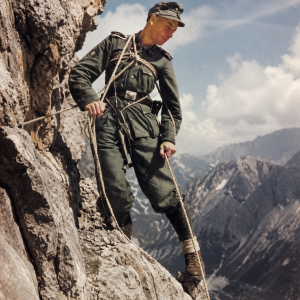
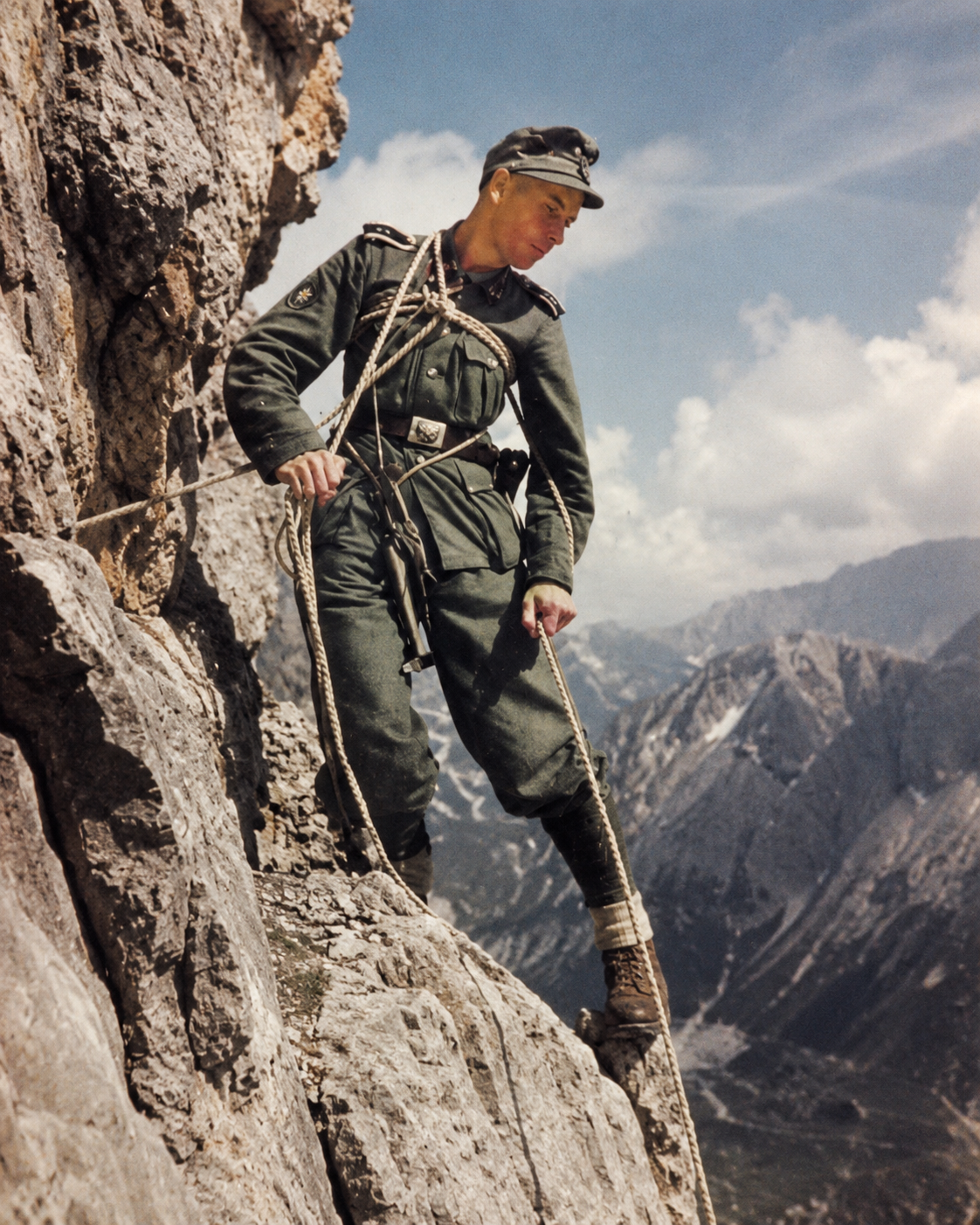
Their instruction went considerably beyond ordinary infantry training. Soldiers learned rifle shooting, fieldcraft, camouflage, patrolling and infantry tactics while simultaneously being taught mountaineering skills. They practised climbing steep rock faces, crossing ravines, moving through snowfields and negotiating glaciers. Ropes, ice axes, crampons and climbing equipment could become almost as important as rifles and machine guns.
Men learned to move in roped groups and were instructed in recognising dangerous snow conditions. Avalanche awareness was essential because an entire patrol or column could be buried without ever encountering the enemy. Rescue techniques were therefore practised, along with methods of recovering injured men from cliffs and steep slopes.
Winter warfare formed another major part of training. Soldiers practised long-distance movement using skis and snowshoes, built shelters in snow and learned how to survive extreme temperatures. Frostbite prevention, clothing management and the maintenance of weapons in freezing conditions were treated seriously. Oil could thicken, metal could freeze and weapons exposed to moisture could become useless if improperly maintained.
Training areas throughout Bavaria and Austria provided realistic conditions. Locations around Mittenwald, Garmisch-Partenkirchen, Berchtesgaden and the Alpine regions of Austria were particularly suitable. Mittenwald became closely associated with German mountain warfare training and remains connected with Germany’s mountain forces today.
Officers and specialist instructors often included experienced civilian mountaineers. Some soldiers received advanced instruction as military mountain guides, known for their ability to select routes through particularly dangerous terrain. Such men needed an understanding of climbing, navigation, weather, snow stability and survival techniques and could guide detachments across areas that might otherwise appear impassable.
One of the central ideas behind their tactics was that apparently impossible ground could provide a route to surprise an enemy. Instead of always following roads and valleys, small detachments could cross ridges, climb steep slopes and approach positions from directions thought to be inaccessible. A force occupying a dominant ridge or mountain pass could control roads and valleys far below.
Movement remained extremely demanding. Trucks and conventional military vehicles were often useless once units left established roads, so horses and particularly mules became essential. They transported ammunition, food, mortars, radio equipment and artillery components along tracks where vehicles could not travel.
Mountain artillery was specifically designed around these limitations. Weapons such as the 7.5 cm Gebirgsgeschütz 36 could be dismantled into separate loads for movement by pack animals. Once the gun crew reached its destination the weapon could be reassembled and brought into action, allowing artillery to operate in positions that conventional field guns might never reach.
The basic personal weapon remained the Karabiner 98k bolt-action rifle, the standard German service rifle for much of the war. It was powerful, accurate and generally reliable in harsh conditions. Soldiers also carried hand grenades and other standard infantry equipment.
Machine guns were particularly important. The MG34 and later MG42 provided enormous firepower to relatively small groups of men. A machine-gun team positioned above a narrow pass, road or valley could make an approach extremely difficult for an attacking force.
Carrying these weapons was another matter. A machine gun, spare barrels, tripods and thousands of rounds of ammunition represented a considerable load, and every kilogram had to be carried uphill by soldiers or pack animals. Physical endurance was therefore directly connected to battlefield firepower.
MP38 and MP40 submachine guns were used by NCOs, officers and assault troops, while later weapons such as the StG44 appeared in limited numbers as the war progressed. Walther P38 and Luger P08 pistols were also carried by officers and specialist personnel.
Mortars were especially useful because they provided considerable indirect firepower without the weight of conventional artillery. The 8 cm Granatwerfer 34 was particularly valuable. Its components could be carried by several men and rapidly assembled once a firing position was reached.
Anti-tank guns and heavier artillery were employed whenever roads permitted, although they were much harder to move through extreme terrain. Later in the war weapons such as the Panzerfaust gave individual soldiers a powerful means of attacking armoured vehicles without having to drag a conventional anti-tank gun through the mountains.
Their specialist abilities were tested during the invasion of Poland in September 1939, particularly in southern areas where mountainous and broken country restricted ordinary movement. An even more famous campaign came during the German invasion of Norway in 1940.
At Narvik German mountain troops under General Eduard Dietl fought Allied forces amid snow-covered Arctic mountains. Weather could change rapidly, visibility was poor and supplies were difficult to move. Men operated across deep snow and steep slopes and frequently relied upon skis.
The Narvik fighting contributed heavily to the elite reputation later associated with these units. Dietl became one of Germany’s most celebrated commanders and subsequently led forces in northern Finland and the Arctic region against the Soviet Union.
Conditions there were appalling. Winter temperatures could fall far below freezing and there were few roads. Equipment froze, vehicles failed and soldiers could suffer serious cold injuries without ever seeing an enemy. The ability to survive and continue operating became almost as important as conventional combat skill.
Mountain formations were also heavily involved in the invasions of Yugoslavia and Greece during 1941. The Balkan landscape of steep mountains and narrow passes suited their training, allowing specialised infantry to cross ground that could delay heavily mechanised formations.
They also played an important role during the Battle of Crete in May 1941. German airborne forces suffered severe casualties during the initial parachute and glider assaults, and mountain soldiers were subsequently flown into captured airfields aboard Junkers Ju 52 transport aircraft.
Once on the island they reinforced the battered airborne units and helped expand the German positions. Fighting across Crete’s rugged interior again demonstrated the usefulness of troops accustomed to travelling on foot across steep and difficult country.
Perhaps the most dramatic mountain campaign came during the German advance into the Caucasus in 1942. The objective of the wider offensive was connected with the capture of the Soviet Union’s important oil-producing regions, and specialised divisions were used to penetrate the enormous mountain barrier.
Fighting took place at extraordinary altitudes. Men carried weapons and supplies through glaciers, snowfields and high passes where weather could change within minutes. Aircraft and vehicles could provide only limited support in many areas.
During this campaign a German detachment famously climbed Mount Elbrus, more than 5,600 metres high and generally regarded as the highest mountain in Europe, and planted German flags near its summit. The achievement received considerable publicity, although it contributed little to the actual campaign.
The Caucasus advance eventually failed as the wider German position in southern Russia deteriorated following the fighting around Stalingrad. Forces in the mountains had to withdraw before they risked being cut off.
Later in the war these specialised formations fought extensively in Italy and the Balkans and were frequently used against partisan forces. Their ability to operate away from major roads made them particularly useful in rugged areas.
Their wartime reputation cannot, however, be considered purely in terms of military skill. Elements of German mountain formations were responsible for serious war crimes, particularly during anti-partisan operations in Greece and the Balkans.
One of the best-known incidents followed Italy’s withdrawal from the Axis alliance in September 1943. On the Greek island of Kefalonia, soldiers of the Italian Acqui Division resisted German attempts to disarm them. After the Italians surrendered, thousands were killed, including large numbers of prisoners who were executed. German mountain troops were involved in the operation.
Other reprisals against civilians occurred during operations in Greece and elsewhere in the Balkans. These atrocities form an important part of the history of the units and should not be separated from accounts concentrating on their military achievements.
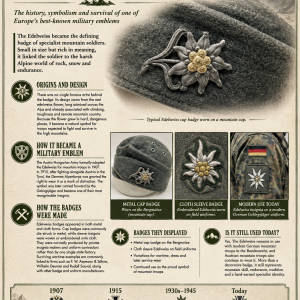
Their appearance was distinctive. The most famous emblem was the Edelweiss, a flower traditionally associated with Alpine mountaineering. A metal Edelweiss badge was normally worn on the left side of the mountain cap, while an embroidered version appeared on the uniform sleeve.
The practical Bergmütze mountain cap became another recognisable feature. Specialised boots, trousers and cold-weather clothing were issued, with heavily constructed footwear suitable for climbing and long marches over rocky terrain.
Snow camouflage was used when required, while equipment could include ropes, pitons, ice axes and other items more normally associated with civilian mountaineering. A soldier could therefore find himself carrying a rifle and grenades together with climbing equipment, winter clothing, food and ammunition.
Supply presented a constant problem. Men working at altitude consumed enormous amounts of energy, yet everything they ate had to reach them along the same difficult tracks they had climbed. Pack animals became vital, and some remote positions depended almost entirely upon mules.
Communications could also prove troublesome because mountains interfered with radio signals. Telephone cable sometimes had to be laid across valleys and over ridges, while radio equipment itself had to be physically carried to the position where it was needed.
Evacuating casualties was equally difficult. A wounded man might have to be lowered from a cliff using ropes and then carried for hours before reaching a road or medical station. Mountain medical personnel consequently learned specialist methods for stabilising and transporting casualties in extremely difficult terrain.
A typical division included mountain infantry regiments supported by artillery, engineers, signals troops, reconnaissance elements, medical units and supply formations. It could operate on ordinary ground when necessary, but its real value became apparent in country where conventional infantry and vehicles struggled.
Junior leadership was particularly important because individual groups could become separated by mountains, valleys, snowstorms or poor communications. NCOs and junior officers often needed to make decisions independently rather than wait for instructions from higher headquarters.
Attacks frequently involved taking high ground before advancing along valleys. Patrols might climb during darkness, occupy a ridge above an enemy position and attack at dawn. A relatively small number of soldiers controlling the heights could sometimes dominate a much larger force below.
The mountains could nevertheless destroy even experienced troops. Avalanches, frostbite, exhaustion, falls and exposure killed men without enemy involvement. Pack animals died, weapons froze and supply columns disappeared in snowstorms. In mountain warfare the environment itself effectively became another opponent.
By the final years of the conflict, replacements increasingly arrived with less specialist experience as Germany’s manpower shortages became more severe. Veteran climbers and experienced mountain soldiers still formed the core of some formations, but the exceptionally high standards possible earlier in the war became increasingly difficult to maintain.
Although never numerically comparable with Germany’s ordinary infantry, armoured and mechanised forces, the mountain troops provided a capability that few conventional divisions could match. Their artillery could be dismantled and placed on pack animals, their machine-gun teams could climb routes considered inaccessible and their soldiers were expected to ski, climb, fight and survive while carrying much of what they required on their backs.
The tradition did not disappear with the defeat of Nazi Germany in 1945. When the democratic West German Bundeswehr was created in the 1950s, specialist mountain infantry eventually became part of the new German Army, although the modern force belongs to an entirely different military and political tradition from the Wehrmacht.
Today the Bundeswehr still maintains a substantial mountain warfare capability through Gebirgsjägerbrigade 23 “Bayern”. Based in Bavaria, it is the German Army’s major formation specialised for operations in difficult and extreme terrain and harsh climatic conditions. The brigade contains around 4,000 soldiers distributed across several Bavarian locations, with Gebirgsjägerbataillone 231, 232 and 233 forming its three principal mountain infantry battalions.
Remarkably, some techniques that were essential eighty years ago remain useful. Modern troops are trained in climbing, skiing, survival and warfare in high mountains and Arctic conditions. The brigade even retains specialist pack-animal capability for places that modern vehicles still cannot reach, using mules, donkeys and Haflinger horses to transport loads through extreme terrain.
The Edelweiss also survives as the traditional symbol of German mountain soldiers. Its continued use connects modern troops with a much older Alpine military tradition, although today’s Bundeswehr carefully exists within the democratic institutions of modern Germany rather than the armed forces of the Nazi period.
From the Arctic snow around Narvik to Crete and the enormous peaks of the Caucasus, Germany’s wartime mountain soldiers operated across some of the most difficult terrain encountered during the Second World War. Their story combines remarkable physical endurance, unusual weapons, specialist training and extraordinary feats of mobility with the darker reality of atrocities committed by some formations. More than eighty years later, the need for soldiers capable of fighting where ordinary vehicles and infantry struggle has not disappeared, and Germany still maintains thousands of specially trained mountain troops for precisely that purpose.